

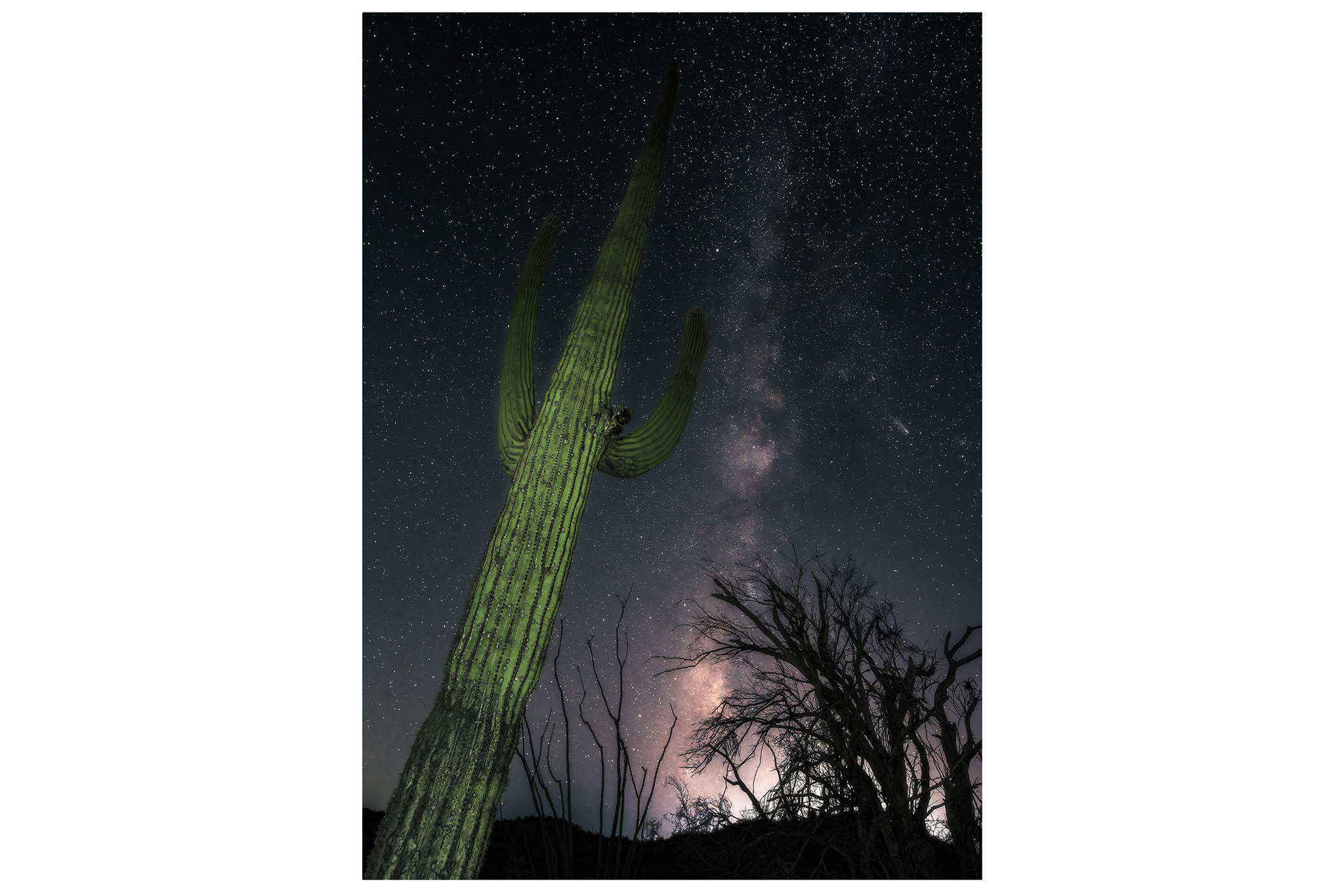
Look in the middle-right of the photo above and you will see what looks like a small white smudge. That is Comet C/2023 A3 (Tsuchinshan–ATLAS).
Yes, the name is a mouthful — brought to us by the naming convention used by The International Astronomical Union (IAU). The “C” is the comet’s category: a long period comet with an orbit longer than 200 years. In the case of Comet Tsuchinshan–ATLAS, it completes its orbit once every 80,000 years. This means it is only visible from Earth for a short period every 80,000 years as well.
Now, imagine what it was like here the last time Earthlings could see Comet Tsuchinshan–ATLAS. It was the beginning of Wisconsian Glacier Period of the last Ice Age, and while glaciers never made their way into this part of Arizona, the climate was cooler and wetter than it is today. Instead of saguaro and ocotillo and palo verde, vast grasslands thrived here, serving as the pastures for megafauna like Columbian mastodons and American mammoths.
Yet at that time, Homo sapiens had not even made their way into this part of North America. Surely the humans and neanderthals living in Africa, Europe, and Asia noticed the comet’s whimsical tail burning in the western sky. But our ancient ancestors were still some 65,000 years away from reaching Arizona. And surely the giant beasts didn’t even bat an eye at the smudge among the stars.
I don’t know about you, but it makes me realize that in the grand scheme of things, we’re only here for a flash. To get to see a once-every-80,000-years comet fly by, point a camera at it, capture it at the foot of a giant Saguaro no less, and share it with you out there, is a privilege not lost on me.
It’s easy to get caught up in the struggle of our modern lives — I do it all the time. Thanks to Comet Tsuchinshan–ATLAS for reminding me that we should cherish every moment we have — good, bad, or ugly — because in another 80,000 years, there’s no guarantee our descendants will even be here at all.
Now that I’ve waxed philosophically, here’s some additional info about Comet Tsuchinshan–ATLAS you may like to know:
- The comet was discovered independentally by two observatories: China’s Purple Mountain Observatory (known as Tsuchinshan in postal romanization) on January 9th, 2023; and South Africa’s Asteroid Terrestrial-impact Last Alert System (ATLAS) on February 22nd, 2023
- The comet has passed perihelion and was visible to the naked eye up until October 26th
- The comet is becoming fainter but will still be visible with binoculars in early November and with a telescope in the coming months — and you can still capture it with a camera (on a tripod, telephoto lens recommended)
- The comet can be viewed with visual aids in the southwestern sky about an hour after sunset
- I used the Stellarium app on my iPhone to help me locate the comet in the sky
That is all for today’s Daily Dose…I hope I inspired you to look up at the sky and find a little extra gratitude.
-Jake
Sign up to get the Daily Dose of the Southwest delivered directly to your email inbox every weekday.


